Introducing
cold spraying technology
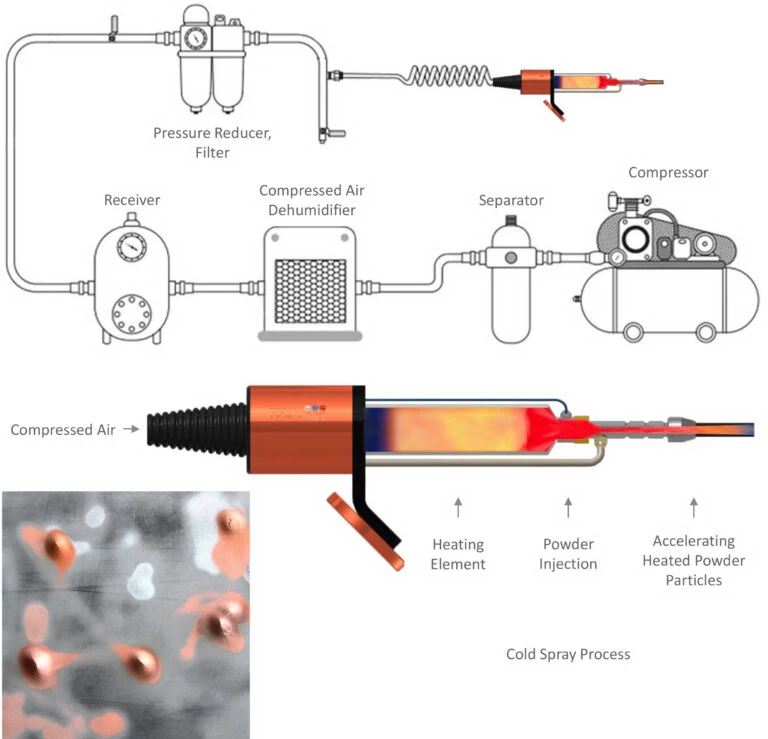
This innovative equipment is equipped with a large number of sensors that ensure optimal control of the cold spraying process. Thanks to new and improved system components, it is now possible to achieve a perfect coating without excessive heating of the part, which prevents undesirable deformation!
Thanks to these properties, cold spraying is widely used in repair shops, mass-production facilities, as well as research centers and institutes. Not only metal substrates can be sprayed, but also glass, ceramics, and certain types of plastic.
These unique metallization systems are portable and easy to use, and in some cases allow repairs to be performed without removing the part. For processing parts that require a uniform coating followed by turning or milling, stationary machines with automatic control are used.
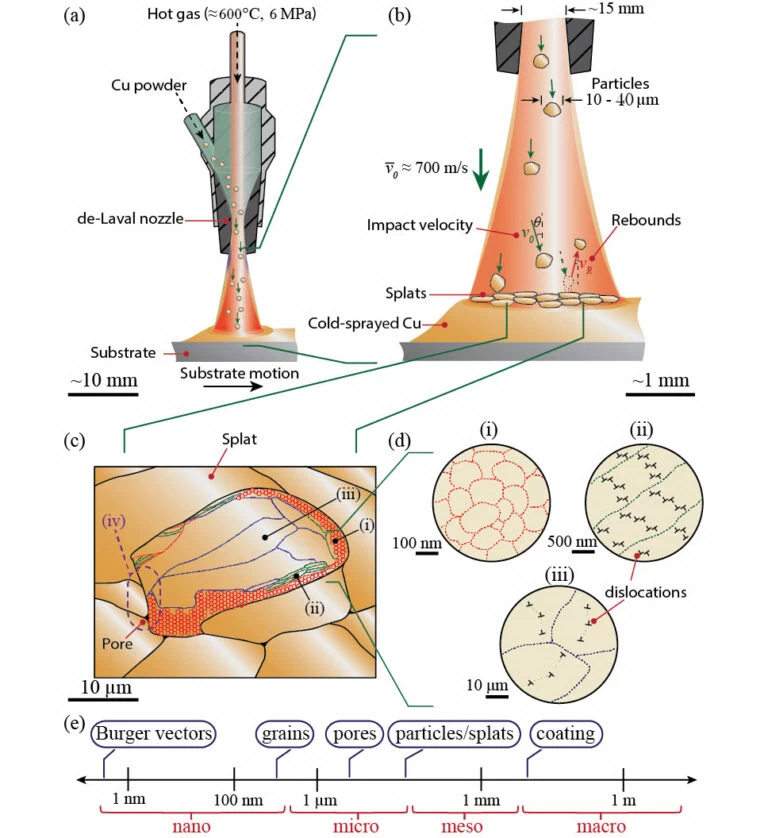
The spraying process is carried out using compressed air, which accelerates the metal powders to supersonic speeds. The impact force causes the powders to bond firmly to the surface of the workpiece, forming a monolithic metal layer with the base properties of the sprayed metal.
The low-pressure cold spraying process
Upon impact with the substrate or previously deposited particles, the particles’ kinetic energy is converted into plastic deformation and, in part, into heat. The particles do not melt during this process, which makes it possible to create coatings with low oxide content and residual stresses.
The correct temperature of the compressed air and its pressure—which must be at least 6 bar—play an important role in creating a high-quality coating.
Aluminum, copper, zinc, and nickel powders, as well as mixtures of these metals, are used to produce coatings.